
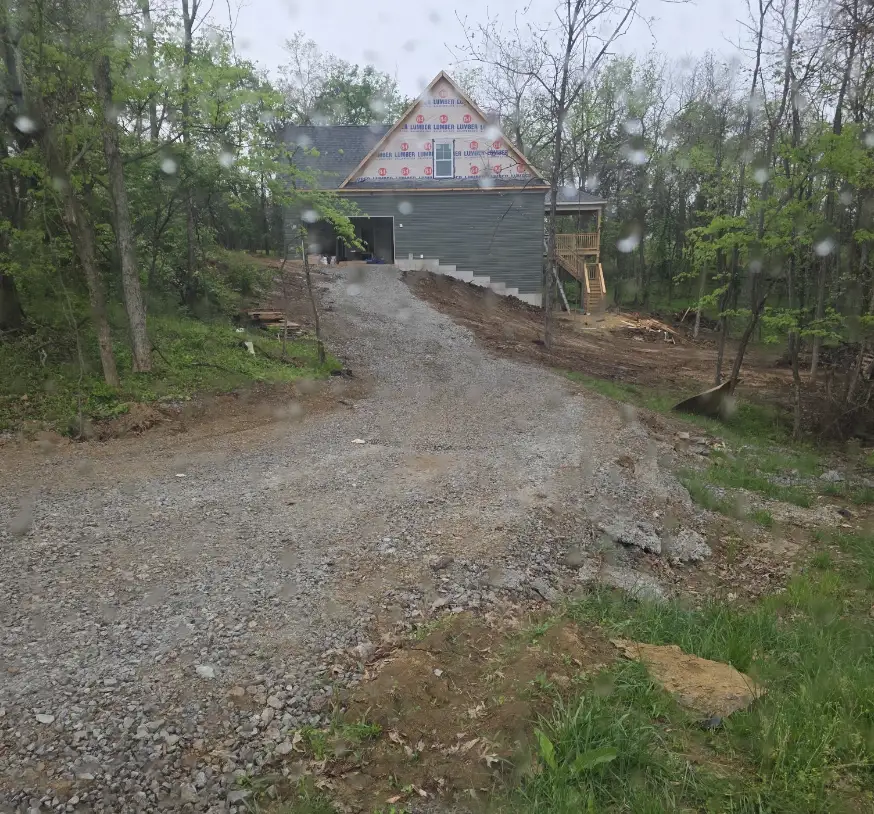
What Does a Gravel Driveway Cost in Kentucky?
People ask for a price per foot, and two drives of the same length can come out far apart. Here is what actually moves the number on a gravel driveway in Kentucky.
Length and width
Start with the obvious one. A drive is priced on how much ground has to be cut and how much stone has to cover it, and both grow with length and width together. A lane wide enough for a pickup is one thing. A drive that has to pass a concrete truck, give two vehicles room to meet, or include a turnaround at the house covers a lot more ground. Decide what has to use the drive before you measure it, because adding width later means redoing the edges and ditches.
Slope and the route
Flat ground is the least work. A drive that climbs a hill has to be cut into the slope, with the uphill bank laid back and the water turned off the drive every so often so it cannot build speed. Sometimes a longer route with an easier climb costs more to build and far less to keep up. Steep drives also need a tighter top stone and a stronger crown to hold. In the Knobs and around the lakes, slope is often the biggest single factor in the price.
The base under the stone
What you drive on is the top few inches. What holds it up is underneath. Topsoil has to come off, since it stays soft, and how deep it runs changes how much digging there is and how much base stone it takes to come back up to grade. Firm clay or shallow limestone needs less base. A wet bottom or a soft pocket needs more. This is the part a delivery quote leaves out, and it is the reason a built drive costs more than a spread load, and lasts.
Drainage: crown, ditches and low spots
Water ruins more gravel drives than traffic does. Shaping a crown and cutting side ditches is machine time, and a drive that crosses a draw or a wet-weather branch needs the water carried under or around it. Where a pipe is needed, at a low spot or at the road entrance, that pipe is supplied and set by a pipe installer or the road department, and it is a separate cost to plan for. We shape the drive and ditches to work with it. Money spent on drainage is what protects everything else you paid for.
Getting machines and trucks to the work
Access cuts both ways. If stone trucks can back straight down the route and spread as they go, the job moves fast. If the drive starts at a narrow gate, crosses soft ground or winds through trees, the stone has to be dumped at the road and carried in by skid steer a bucket at a time. Overhead lines, tight turns and a neighbor's fence slow things down too. None of it stops a job, but hours on the machine are a real part of the bill.
How far the stone has to travel
Crushed limestone is quarried across central Kentucky, and the stone itself is usually not the expensive part. Trucking is. Every load is priced partly on the distance from the quarry to your gate, so the same drive costs more at the far end of a county than it does a short run from the quarry. The type of stone matters as well: base stone and top stone are priced differently, and a long drive can take a lot of loads. That is why stone is figured into the job, not guessed at.
Trees, stumps and old drives
A drive to a wooded home site starts as a clearing job. Trees along the route come down, and every stump under the drive has to be pulled, because a stump left to rot leaves a soft hole. That adds time before any stone shows up. Reworking an existing drive usually costs less than building new, since the route and some of the base are already there. Cutting out the potholes, restoring the crown and adding stone where it is thin can bring an old drive back.
Part of a build, or a job by itself
If the drive is part of a new house, shop or barn, it usually costs less to do it with the rest of the dirt work than as a separate trip. The machines are already there, the topsoil is being stripped anyway, and the pad, the approach and the drive can be shaped as one piece. Many builds get the base in first so trucks can reach the site, then the top stone after construction traffic is done. Ask for it to be quoted that way. Our gravel driveways page shows what goes into the work.
Getting a real number
A real number takes a look at the route. Call (270) 272-8739 or send the form with where the drive is and what it leads to. Trey will walk it with you and give you a straight quote before any work starts.
See our gravel driveways service or call (270) 272-8739.
Gravel Driveways near you
More guides
Ready to Get Dirt Moving?
Call Trey or send the details. You'll get a straight answer on what the job takes.