
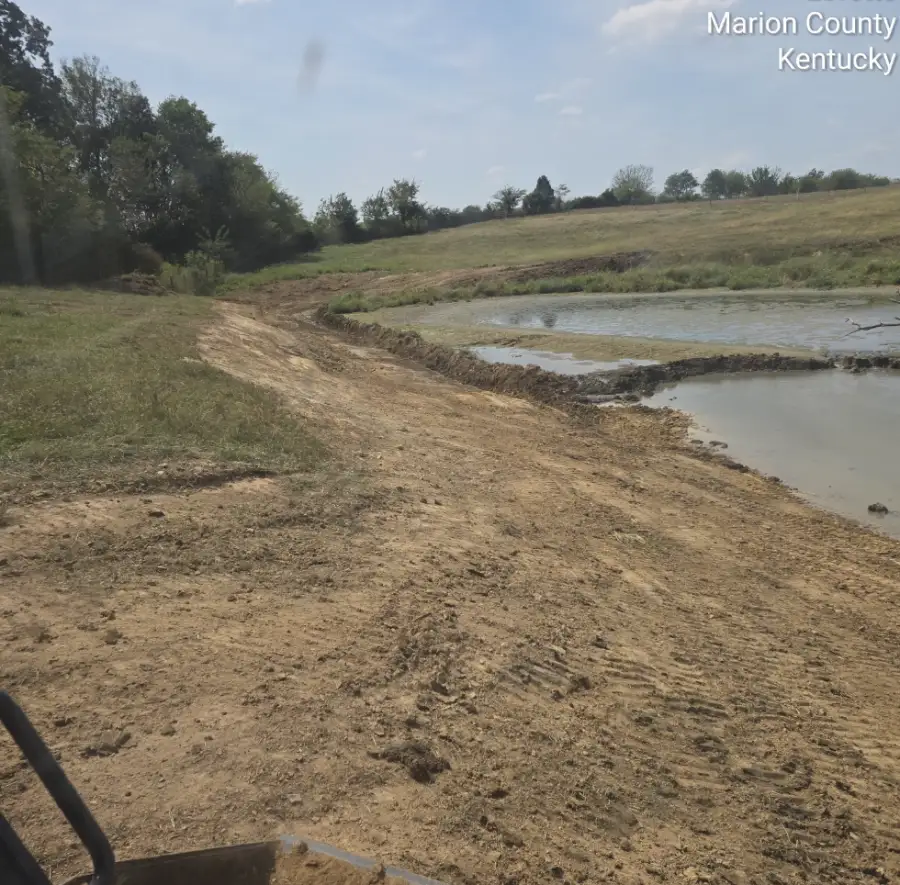
Do You Need a Permit to Build a Pond in Kentucky?
Most farm ponds in Kentucky are smaller than the size that needs a state dam permit, but that is not the same as having no rules to check. Here is what the state looks at, who to call, and what makes a site hold water once the paperwork is settled.
The short answer
It depends on three things: how big the dam is, whether the pond touches a stream or wet ground, and where you live. Kentucky does not have one simple farm pond permit that everybody gets. It has a dam safety rule for big dams, a stream construction rule for work in or along streams, and a utility locate law that covers any digging. Most small ponds built in an upland draw fall below the first and away from the second, but that is a question to put to the office in charge, not something to assume. The sections below go through each one.
Dam safety: 25 feet or 50 acre-feet
The Kentucky Division of Water runs the state dam safety program. A dam safety permit is required when a dam is 25 feet high or more, or when it can hold 50 acre-feet of water or more. Either one triggers it. An acre-foot is one acre of water one foot deep, so 50 acre-feet is a large pond. The typical farm pond is well below both numbers. The place this catches people is a dam across a deep, narrow hollow, where the height adds up faster than the water does. If your dam will be anywhere close, call the Division of Water before you build.
Streams: the permit people forget
Separate from dam size, Kentucky requires a stream construction permit for work in, along or across a stream. Damming a creek, or digging a pond in a creek bottom, falls in that territory. The Division of Water may consider an exemption where the watershed above the site is under 640 acres, but that is the Division's decision to make, not the landowner's and not ours. A dry draw that only runs after a rain is the usual farm pond site, and it is a very different thing from a creek that flows most of the year. If you are not sure which you have, ask.
Wet ground and wetlands
A spot that stays wet all year looks like a natural place for a pond, and it may come with its own rules. Digging or filling in wetlands and streams can fall under federal law, which the U.S. Army Corps of Engineers handles. If your farm is in USDA programs, wetland rules can also affect your eligibility, and the NRCS office is where those questions get answered. None of this means a pond is off the table. It means you make a call before a machine shows up, so nobody has to undo work later.
Kentucky 811 before any digging
This one applies to every pond, whatever its size. Kentucky law requires notice to Kentucky 811 at least two full working days before digging, so public utilities can be located and marked. A locate ticket is good for 21 days. Farm fields are not empty: gas lines, water mains and buried phone lines cross a lot of pasture. Private lines are not marked by 811. Water lines to a barn or waterer, electric to a well or a gate, and old gas lines are the owner's to point out. Walk the site with us and tell us everything you know is buried.
Who to call, and local rules
Three offices cover nearly every pond question. The Kentucky Division of Water answers dam safety and stream construction permit questions. Your county conservation district, and the NRCS office that works with it, can look at soils and help you choose a site, and that is also the place to ask whether any cost-share applies to your project. Inside city limits or a subdivision, ask the city or county planning office and read your deed restrictions too. Kentucky Fish and Wildlife publishes farm pond planning guidance as well. A few phone calls up front are a small thing next to moving a pond.
What makes a site hold water
A permit does not make a pond hold. Ground does. A pond needs three things: enough land draining to it to keep it full, a thick layer of clay under the water and in the dam, and a spillway that can carry a big storm around the dam. Kentucky clay is good pond dirt. Limestone seams, sinkholes, sand and gravel are not. Karst ground, where water sinks into the rock, is the riskiest. The dam should be keyed into solid clay and built in thin packed layers, with trees and topsoil kept out of it. A site visit settles most of this.
When to build, and who handles what
University of Kentucky guidance is to plan in August, build in September's dry weather and finish before wet winter weather sets in. Clay packs properly when it is dry enough, and machines need firm ground. As for who does what: the permit questions and the calls to the state and county offices are the owner's, and we are glad to talk through what to ask. Trey handles the site visit, the pond digging, the dam, the spillway, the banks and spreading the spoil. If an office wants an engineer's plan for a large dam, the owner arranges that as well.
What to do next
Most Kentucky farm ponds fall below the dam permit thresholds, but every one of them needs the right site and a call to Kentucky 811. Make your calls to the Division of Water and your county conservation district first. Then call Trey at (270) 272-8739, and he will walk the ground with you and give you a straight quote before any digging starts.
See our pond digging service or call (270) 272-8739.
Pond Digging near you
More guides
Ready to Get Dirt Moving?
Call Trey or send the details. You'll get a straight answer on what the job takes.