
What Does a Building Pad Cost in Kentucky?
Two pads the same size can cost very different amounts, because the building is not what you are paying for. The ground under it is. Here is what changes the number.
The size of the pad, not the building
A pad is always bigger than what sits on it. The crew needs room to work outside the walls, and the edge of a slab should not sit on the soft shoulder of the fill. So a shop pad is the shop plus a margin on every side, and the margin adds up faster than people expect. Start with the building's outside dimensions and ask your builder or kit supplier how much extra they want. That finished footprint is what gets cleared, cut, filled, compacted and stoned.
Slope, and how much cut and fill it takes
Slope is the biggest swing in a pad price. On ground that is nearly level, the work is stripping topsoil and bringing the site up a little. On a hillside, the uphill half is dug out and the downhill half is built up, and the amount of dirt moved climbs steeply with every foot of fall. In the Knobs and on lake lots, that can be most of the job. A pad that can be turned or slid to a flatter spot on the same lot often costs far less.
Fill dirt: what you have and what gets brought in
When the cut on your own lot makes enough good dirt to build the low side, the pad balances and nothing has to be bought. When it does not, fill gets trucked in, and you pay for the dirt, the trucking and the time to place it. Not all dirt is fill. Topsoil, roots, sod and wet muck cannot go under a building. Good clay can. If the site is short on usable dirt, or a pond or basement dig nearby is making extra, say so up front.
Compaction
Dumping fill and smoothing the top is quick. It is also how pads settle. Fill has to go down in thin layers, each one packed before the next goes on, with the dirt at a workable moisture. That takes more passes and more hours than pushing a pile flat, and it is the part of the quote you should not try to trim. A deep fill done in lifts will carry a building. The same fill dumped in one go can keep sinking for a long time.
Stone: how deep and how much
The stone on top gives the concrete crew a firm, drained, level base and keeps the pad from turning to mud while the building goes up. Stone is sold by weight, so depth times area drives the bill. A house slab, a shop floor that will carry a tractor and a pole barn pad with a gravel floor do not all need the same depth. Your builder or concrete crew usually sets it. How far the quarry is from your lot matters too.
The drive and the approach
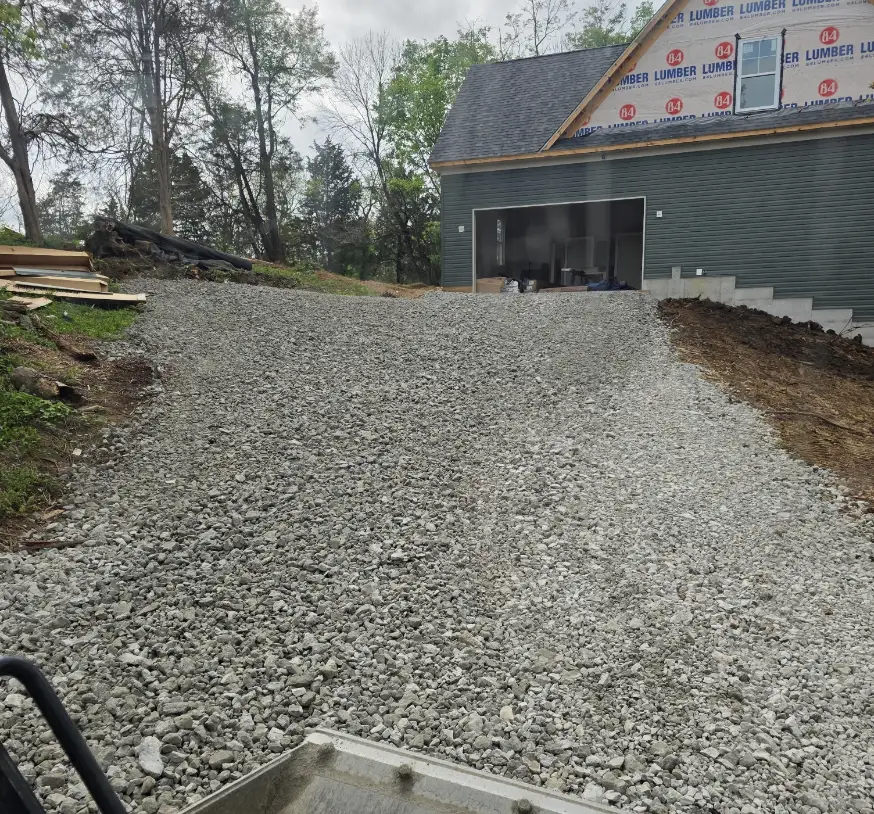
A pad nobody can reach is not finished. Concrete trucks, lumber trucks and the building crew's trailer all have to get from the road to the pad without sinking. A short approach off an existing drive is a small add. A new lane across a field or up through woods is a job of its own, with clearing, a cut, a base and stone. Price the pad and the access together, since they are built with the same machines on the same trip. The gravel driveway cost guide covers that side.
Drainage around the pad
Water has to leave the pad and not come back. On flat ground that means raising the pad and shaping the yard to fall away. On a slope it means a swale cut above the pad to turn hillside water around the building. Both take machine time, and both cost little next to a wet shop floor. In sinkhole country such as Hardin County, where the water ends up needs more thought, and sometimes an engineer's word.
Rock, trees and what is in the way
A clean hayfield is the low end. Trees have to be cleared and the stumps pulled, since a stump left under fill rots and leaves a soft spot. An old foundation, a buried cistern or a pile of fence wire has to come out. Limestone close to the surface can stop a cut and turn it into a fill job. None of that is unusual in Kentucky, and all of it is easier to price when somebody has walked the ground first.
Getting a real number
Stake the corners, find out what your builder wants under the building, and have Trey walk the lot. Call (270) 272-8739 or send the form, and you will get a straight quote for your pad on your ground before any work starts.
See our building pads service or call (270) 272-8739.
Building Pads near you
More guides
Ready to Get Dirt Moving?
Call Trey or send the details. You'll get a straight answer on what the job takes.